
Aggregated reports
Analyzing a single flop is useful, but what if you could analyze all 1755 flops at once? That's the power of Aggregated Reports. This tool moves you from the micro (one board) to the macro (your entire strategy), helping you spot high-level patterns and find leaks you never knew you had.
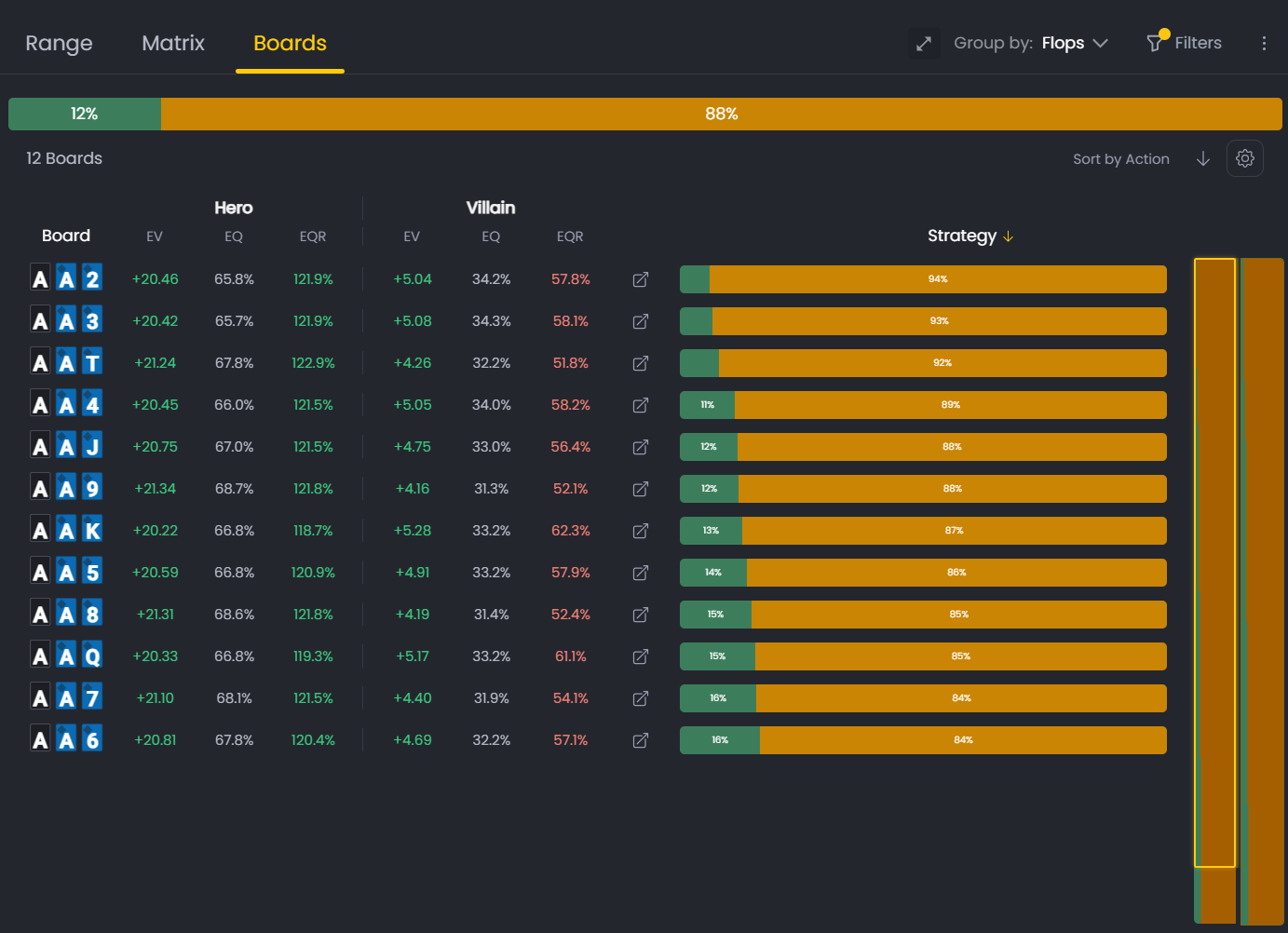
How to Access Aggregated Reports
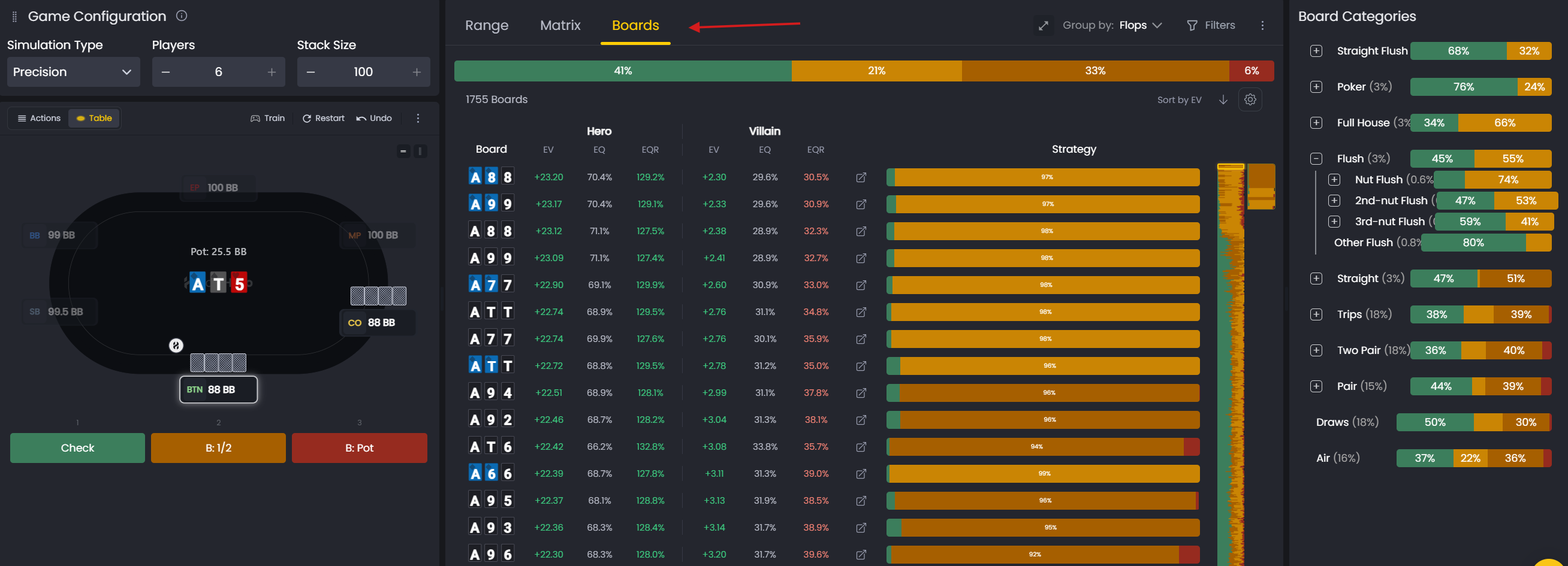
Aggregated Reports is available in the Strategies module whenever you are on the Flop street.
- Navigate to Strategies and set up your preflop scenario (e.g., BTN opens, BB calls).
- Select any flop to advance to the Flop street.
- Click the Boards tab (next to Range and Matrix).
You'll now see the Aggregated Reports view, showing data for all 1755 possible flops in your scenario.
What You're Looking At
Before we dive into insights, let's understand the key elements on screen.
The Overall Strategy Bar
At the very top, you'll see a horizontal bar showing the aggregated strategy across all flops. This is your baseline — it tells you, at a glance, how often the active player should Check, Bet small, or Bet large across the entire board universe.
For example, if you see 90% green (Check) and 10% red (Bet), you know this player should be very passive in this spot overall.
The Boards List
Below the strategy bar, you'll find a list of all 1755 flops with key metrics for both the Hero and Villain.
- Board is the three flop cards.
- EV is the Expected Value for that specific flop.
- EQ is the Equity percentage.
- EQR is the Equity Realization.
- Strategy is a mini strategy bar for that individual flop.
You can click any flop to open it in the main Strategies viewer for deeper analysis.
Board Categories Panel
On the right side, the Board Categories panel shows how different hand types perform. Categories include Straight Flush, Quads, Full House, Flush, Straight, Trips, Two Pair, Pair, Draws, and Air.
Each category displays the strategy breakdown (Fold vs Check vs. Bet frequencies), helping you understand how hand strength affects your betting patterns. You can expand each category to see more detailed breakdowns.
Group By
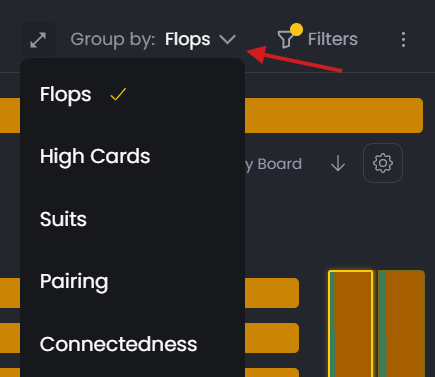
The Group by dropdown lets you combine flops by shared characteristics.
- Flops (default) lets you view each flop individually.
- High Cards groups all A-high, K-high, Q-high flops together.
- Suits groups by Monotone, Two-tone, and Rainbow. Pairing groups by Unpaired, Paired, and Trips.
- Connectedness shows how connected the board is.
Filters
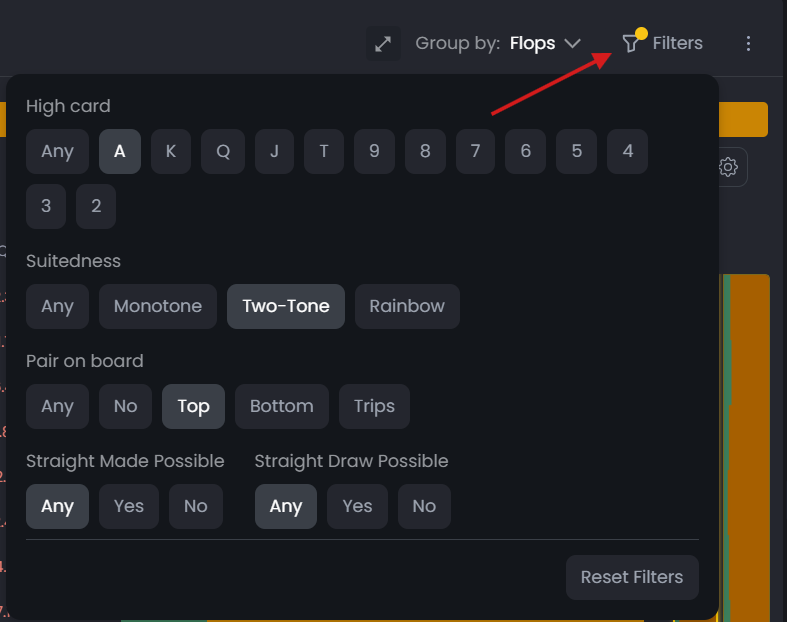
Use Filters to narrow down to specific textures. You can filter by high card, suitedness, pairing, and more. This is especially useful when combined with Group by to isolate specific board types.
Sort By
The Sort by button lets you reorder the boards list.
- Sort by Board orders alphabetically by high card (A-high first).
- Sort by EV orders by Expected Value.
- Sort by Action orders by betting frequency.
You can also toggle between Ascending and Descending order using the arrow button next to Sort by.
Now let's use these tools to find real insights.
Insight 1: The Power of Position
Let's take one of the most common spots in poker: a single-raised pot between the Button (BTN) and the Big Blind (BB). After the BB calls the BTN's open, who should be doing most of the betting on the flop?
We can answer this instantly with Aggregated Reports.
BB's Perspective (Out of Position)
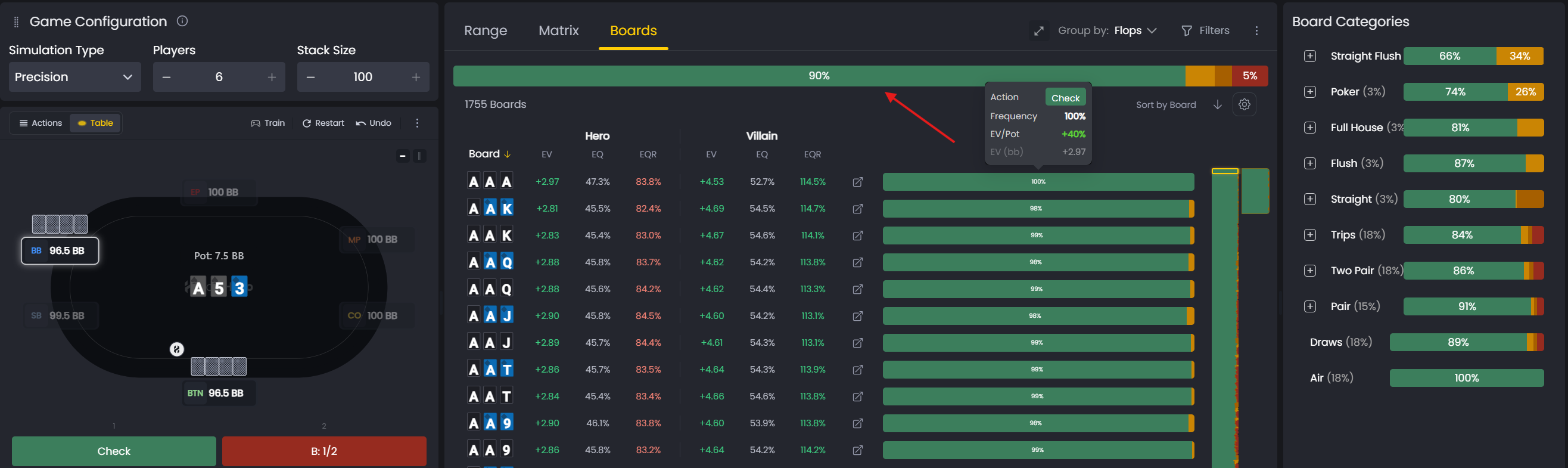
Set up the scenario (BTN Raise, BB Call), go to the Boards tab, and look at the Overall Strategy Bar from the BB's perspective.
Across all 1755 flops, the BB is extremely passive, checking 90% of the time.
BTN's Perspective (In Position)
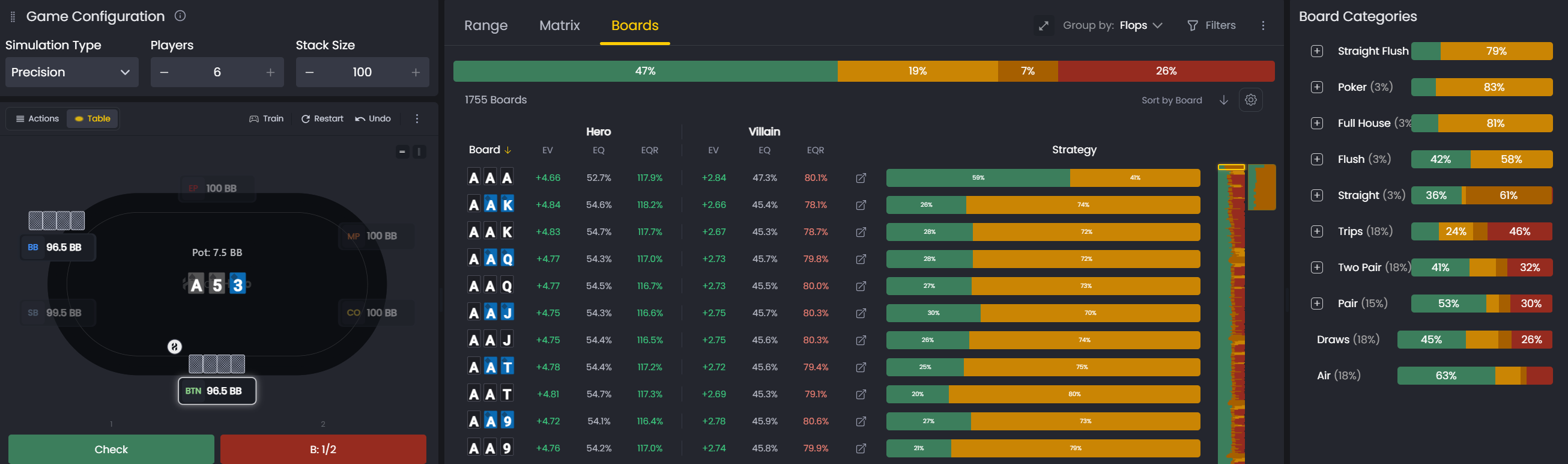
Now click BB Check to advance the action, and look at the BTN's strategy bar.
The difference is massive. The BTN bets over 50% of the time, taking control of the pot.
Takeaway: Position is everything. GTO strategy is to play very passively when out of position against the pre-flop aggressor and much more aggressively when in position mostly due to nuts and range advantage. Use Aggregated Reports to see this pattern across all boards instantly.
Insight 2: Are You Bluffing Correctly?
When should you bluff? The Board Categories panel gives us the answer.
BB with Air
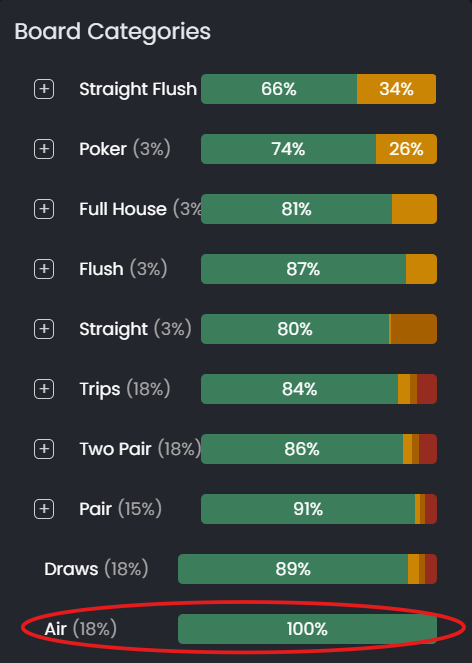
From the BB's perspective, look at the "Air" category in the Board Categories panel.
The BB checks 100% of the time with pure air. There is no leading/donk-betting as a bluff when out of position.
BTN with Air
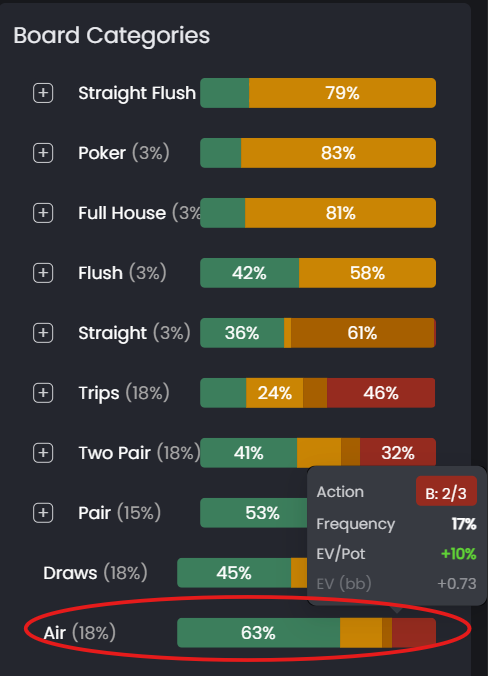
Now look at the BTN's strategy with "Air" after the BB checks.
The BTN continuation-bets with Air over 30% of the time.
Takeaway: The player in position has the license to bluff. The player out of position does not. If you're donk-betting flops with air as the BB, you're likely leaking value. If you're not c-betting as a bluff on the BTN, you're missing profitable opportunities.
Insight 3: How Board Texture Changes Your Strategy
Does the type of board change this dynamic? Let's use the Group by dropdown to find out.
Group by High Cards
Select Group by: High Cards and compare the BB's strategy on different board heights.
- On A-high boards, the BB checks 97% and bets only 3%.
- On K-high boards, the BB checks 93% and bets 7%.
- On Q-high boards, the BB checks 90% and bets 10%.
- On 6-high boards, the BB checks 80% and bets 20%.
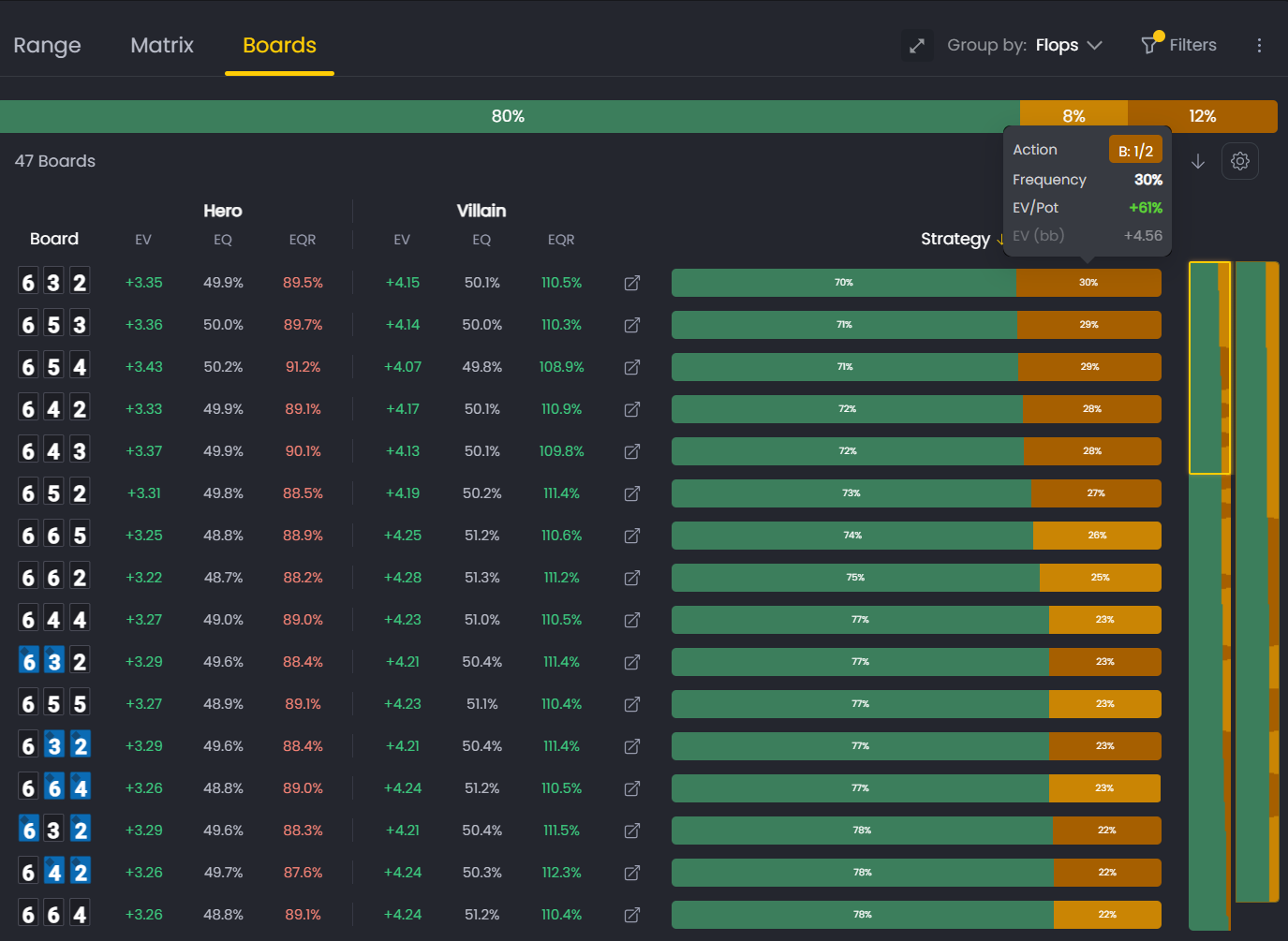
Takeaway: The BB is more likely to bet on low boards, which connect better with their calling range. A-high boards favor the BTN's opening range, so the BB must play even more cautiously.
The Opposite Pattern for BTN
Now flip to the BTN's perspective.
- On A-high boards, the BTN checks 42% and bets 58%.
- On K-high boards, the BTN checks 49% and bets 51%.
- On 6-high boards, the BTN checks 47% and bets 53%.
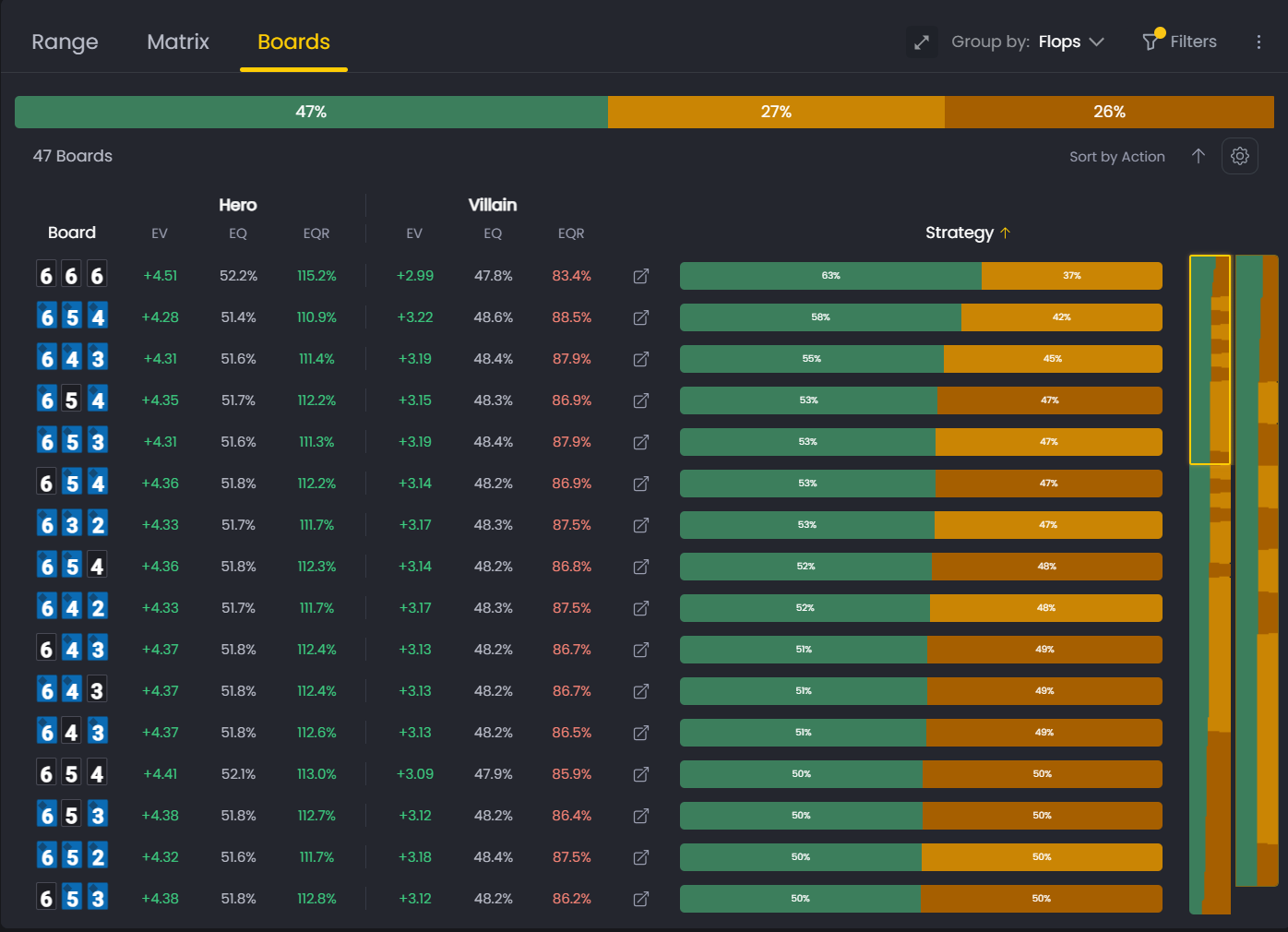
The BTN presses their range advantage on high-card boards and proceeds more cautiously on low boards that are better for the BB.
Your Turn: A Quick Workflow for Finding Insights
You can apply this same process to any situation.
- Choose a spot you want to study (e.g., 3-Bet Pot, CO vs. SB).
- Go to the Flop and open the Boards tab to see Aggregated Reports.
- Start with the big picture by looking at the Overall Strategy Bar for both players (IP vs. OOP). This gives you your baseline.
- Group by different textures (High Card, Suits, Connectedness) to find patterns. Ask yourself: "How does my strategy change on different board types?"
- Check the Board Categories to see how often you should be betting with monsters versus air. Are you bluffing enough or too much?
- Click any flop to dive deeper into the Range and Matrix tabs for that specific board.
By moving from a single flop to the aggregated view, you can stop guessing and start building a robust, GTO-informed strategy for every spot.
Was this article helpful?
Still need help?
Join our community
Get instant support from experts and fellow players
Join Discord Community